
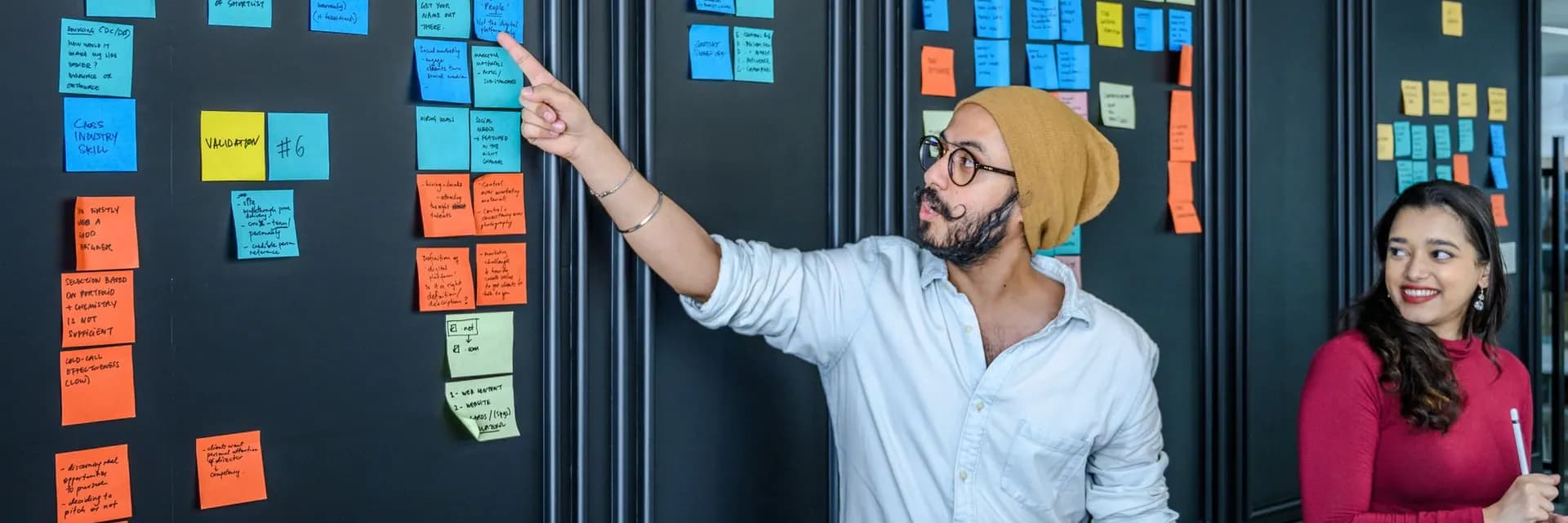
A delivery process you can see into at any moment
Agile done properly: short feedback loops, visible progress and quality built into the pipeline. You always know what was done, what is next and what it costs.
- Step 1
Discover
Goals, users, constraints
- Step 2
Design
Flows, prototypes, UI system
- Step 3
Build
Two-week sprints, demos
- Step 4
Assure
Automated and manual QA
- Step 5
Launch
CI/CD, observability


Six stages, from idea to scale
- 11 to 3 weeks
Discover
Stakeholder workshops, user interviews, current-system review and a prioritised feature map.
You receive: Scope document, architecture outline, estimate and delivery plan
- 22 to 4 weeks, overlapping build
Design
User flows, wireframes, a clickable prototype tested with real users and a UI component library.
You receive: Figma prototype, design system, usability findings
- 3Two-week sprints
Build
Planning, daily stand-ups, code review on every pull request, and a demo of working software every sprint.
You receive: Deployed increments, sprint report, updated backlog
- 4Continuous
Assure
Automated unit, integration and end-to-end tests grow with the code; exploratory and accessibility testing each sprint.
You receive: Test reports, coverage trends, defect log
- 51 to 2 weeks
Launch
Load testing, security review, production cut-over plan, monitoring and alerting, and team training.
You receive: Go-live checklist, runbooks, dashboards
- 6Ongoing
Scale
Analytics review, performance tuning, roadmap planning and support under an agreed service level.
You receive: Monthly product report, SLA reporting, roadmap
Parallel tracks keep timelines short
Design runs a sprint ahead of engineering, and QA automation starts in sprint one rather than at the end.
| Workstream | W1W2W3W4W5W6W7W8W9W10W11W12 | |||||||||||
|---|---|---|---|---|---|---|---|---|---|---|---|---|
| Discovery | Workshops and scope | |||||||||||
| UX and UI design | Flows, prototype, design system | |||||||||||
| Engineering | Sprints 1 to 4: build and demo | |||||||||||
| QA automation | Test suites grow with every sprint | |||||||||||
| Cloud and DevOps | CI/CDHardening | |||||||||||
| Launch | Go live | |||||||||||
Meetings with a purpose
| Ritual | Cadence | Purpose |
|---|---|---|
| Sprint planning | Every two weeks | Agree goals and scope for the sprint with your product owner. |
| Daily stand-up | Daily, 15 minutes | Open to you; blockers raised and resolved the same day. |
| Sprint demo | Every two weeks | Working software on a staging environment, not slides. |
| Retrospective | Every two weeks | What to keep, change and stop, with actions tracked. |
| Steering review | Monthly | Budget, timeline, risks and roadmap with decision makers. |
Release quality gates
Commit
Linting, type checks, pre-commit hooks
Peer review
Every change reviewed by a second engineer
Automated tests
Unit, integration and end-to-end suites
Security scan
SAST, dependency and secret scanning
Staging
Product owner sign-off on a live build
Production
Zero-downtime deploy with rollback
Have a product to build or a system to fix?
Tell us where you are and what you need. A senior engineer replies within 24 hours with next steps, not a sales script.